Digestive Enzyme Powders in Sachets and Stick Packs: Production Notes for Supplement Teams
For dietary supplement manufacturers, sachets and stick packs change the digestive enzyme formulation brief. A powder serving has to dose cleanly, disperse predictably, tolerate flavor systems, and remain aligned with its finished-product specification through manufacturing, packing, storage, and distribution.
Enzymeslink supplies bulk digestive enzymes for supplement manufacturers developing powder formats, including custom digestive enzyme blends built around ingredient compatibility, dosage format, documentation needs, and scale-up realities.
This guide outlines the production questions formulation and operations teams should resolve before locking a sachet or stick-pack digestive enzyme product.
Why sachets and stick packs require a different enzyme strategy
Capsules protect enzyme powders from many formulation variables. Sachets and stick packs expose the enzyme blend to a broader set of inputs:
- Direct contact with flavors, acids, sweeteners, minerals, fibers, colors, and carriers
- Larger surface area exposure during blending, filling, and storage
- Consumer expectations for taste, mouthfeel, dispersion, and residue
- High-speed filling requirements where flow and consistency matter
- More dependence on packaging barrier, seal quality, and moisture control
A successful powder format is not simply a capsule blend poured into a stick pack. It should be designed as a finished powder system from the start.
Start with the finished-product specification
Before choosing enzymes or excipients, define what the product needs to be at release and through its intended shelf life. For supplement teams, that usually means clarifying:
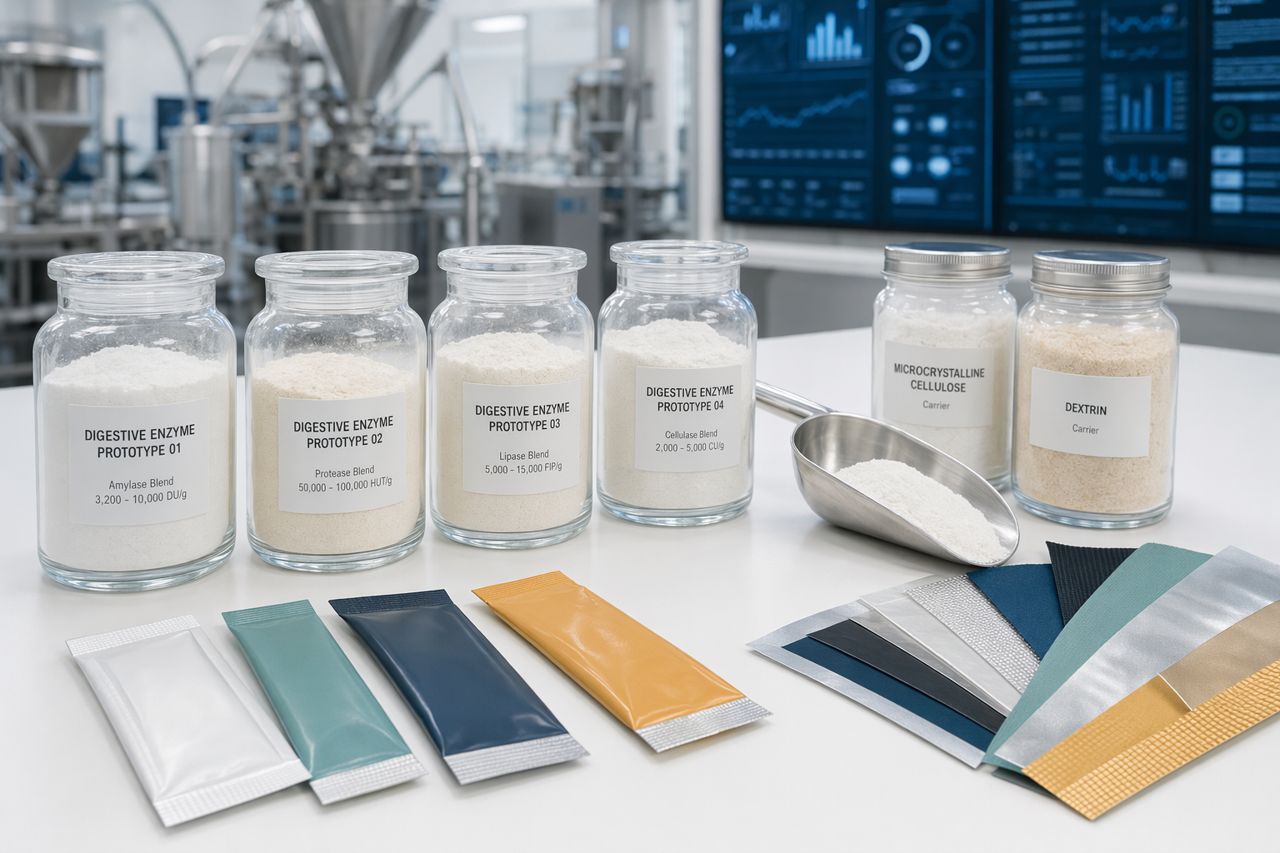
- Target enzyme spectrum, such as protease, amylase, lipase, lactase, cellulase, or other blend components
- Serving format, fill weight range, and desired powder volume
- Flavor direction and sweetness system
- Acidulant use, if any
- Allergen, vegan, non-GMO, kosher, halal, or other market requirements
- Country-of-origin and sourcing preferences
- Label positioning and documentation requirements
- Target markets and regulatory review expectations
- Packaging format, carton configuration, and distribution environment
These decisions influence enzyme selection, carrier strategy, overage planning, and manufacturing controls.
Formulation priorities for enzyme sachets
1. Moisture control
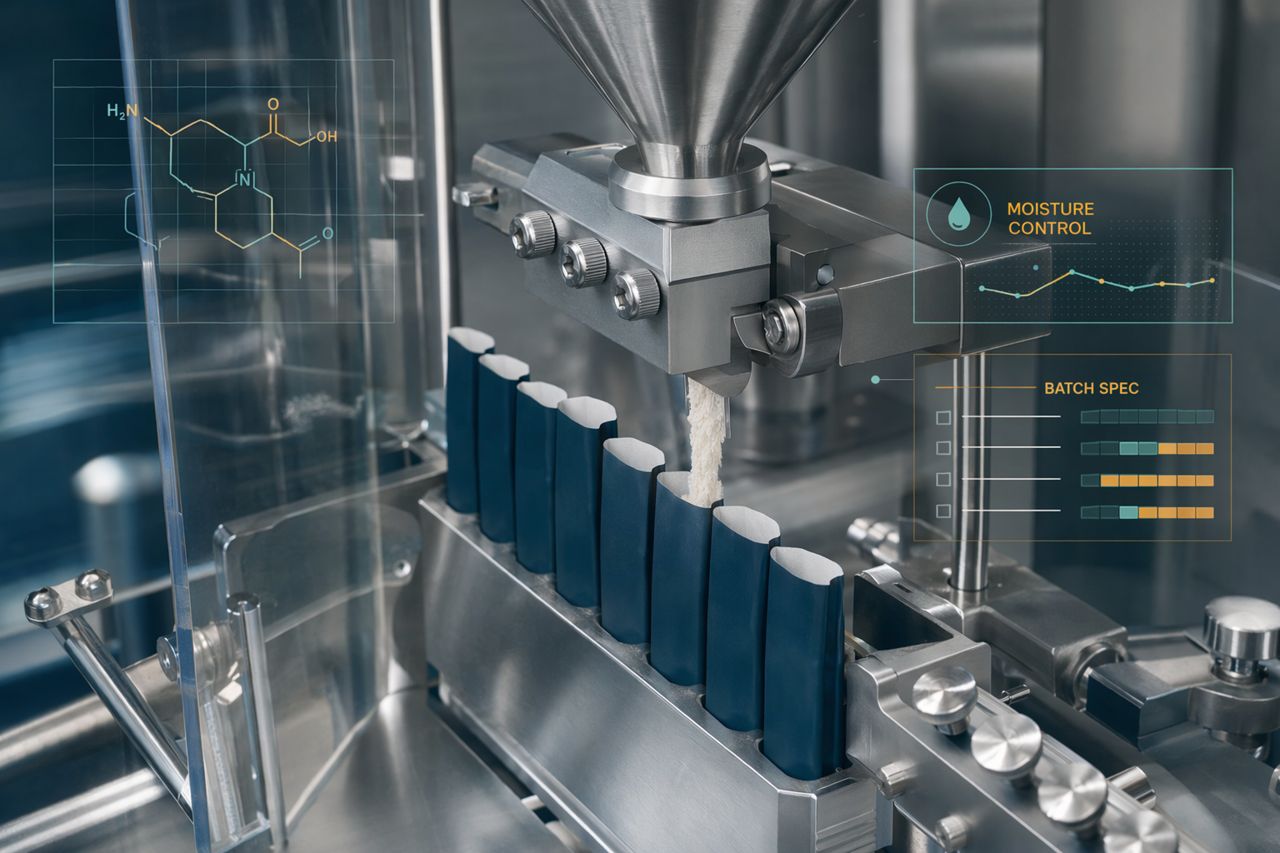
Digestive enzyme powders can be sensitive to moisture exposure. Sachet and stick-pack formats often include hygroscopic ingredients, including certain sweeteners, fibers, flavors, and minerals. Moisture can affect powder flow, clumping, sensory quality, and potency retention.
Practical controls include:
- Selecting low-moisture carriers and compatible excipients
- Reviewing flavor and sweetener moisture behavior before scale-up
- Limiting open-air hold time during blending and filling
- Using controlled room conditions during production
- Choosing packaging films with suitable barrier properties
- Avoiding formulation changes that increase moisture pickup after pilot work
Moisture planning should happen early, not after the first production run shows poor flow or caking.
2. Flow and filling behavior
Stick-pack machines reward powders that move consistently. Digestive enzyme blends may include fine particles, carrier systems, and low-inclusion ingredients that can challenge dosing uniformity.
Formulation teams should evaluate:
- Bulk density and powder volume relative to pack dimensions
- Flow through hoppers, augers, and dosing equipment
- Dusting tendency during transfer and filling
- Compression or compaction behavior during production holds
- Whether a pre-blend or granulated carrier approach is needed
- Whether particle size alignment can reduce segregation risk
A powder that looks acceptable in a lab jar may behave differently in a high-speed filling environment. Pilot-scale handling is essential.
3. Blend uniformity and segregation risk
Digestive enzyme ingredients are often used at different inclusion levels. When enzymes, flavors, sweeteners, acids, and carriers have different particle sizes or densities, segregation can occur during blending, transfer, hopper feeding, or vibration.
To reduce risk:
- Align particle size distribution where possible
- Use a carrier system that supports uniform dispersion
- Avoid excessive blending that may generate fines or heat
- Define a transfer process that minimizes separation
- Confirm blend uniformity after realistic handling steps
Uniformity is especially important in single-serve formats because each sachet or stick pack must represent the intended finished blend.
4. Sensory compatibility
Digestive enzyme blends are functional ingredients, but sachets and stick packs are consumer-facing powder systems. Taste, aroma, mouthfeel, and aftertaste can affect repeat purchase.
Key sensory considerations include:
- Enzyme source profile and inherent odor
- Flavor load required to balance the base powder
- Sweetener selection and aftertaste management
- Acidulant compatibility with the enzyme blend
- Mouthfeel from carriers, fibers, or mineral systems
- Dispersion in water or other suggested use conditions
The best approach is to screen enzyme blend and flavor system together, rather than finalizing them as separate workstreams.
5. Compatibility with acids, minerals, and botanicals
Many sachet concepts combine enzymes with probiotics, prebiotic fibers, electrolytes, botanicals, fruit acids, or greens-style ingredients. These combinations can be commercially attractive, but they may create compatibility pressure.
Review potential issues such as:
- Low-pH powder environments created by acidulants
- Mineral salts that affect taste, flow, or moisture behavior
- Botanical powders that add color, odor, or microbial complexity
- Fibers that increase powder viscosity or clumping
- Probiotic handling needs if included in the same format
Enzymeslink can support compatibility discussions before a concept becomes a locked formula.
Processing notes for supplement manufacturers
Control heat, humidity, and hold time
Enzyme blends should be treated as sensitive functional powders. During scale-up, document where the blend is exposed, how long it remains in process, and what environmental conditions it sees.
Production teams should map:
- Ingredient staging conditions
- Blend time and order of addition
- Transfer points between equipment
- Hopper residence time
- Packaging line temperature and humidity
- Finished-pack storage before release
This process map helps identify preventable stress points.
Design the blend order intentionally
Blend order can affect dispersion, uniformity, and powder handling. In many projects, enzymes should be introduced in a way that protects distribution without excessive mechanical stress.
Common strategies include:
- Creating a compatible carrier pre-blend
- Adding low-inclusion enzymes after larger base components are uniform
- Using flavors and sweeteners in a sequence that avoids localized concentration
- Reducing unnecessary rework loops
- Keeping blending instructions realistic for commercial production
The goal is a process that can be repeated by operations, not just achieved once in development.
Match packaging to the formulation
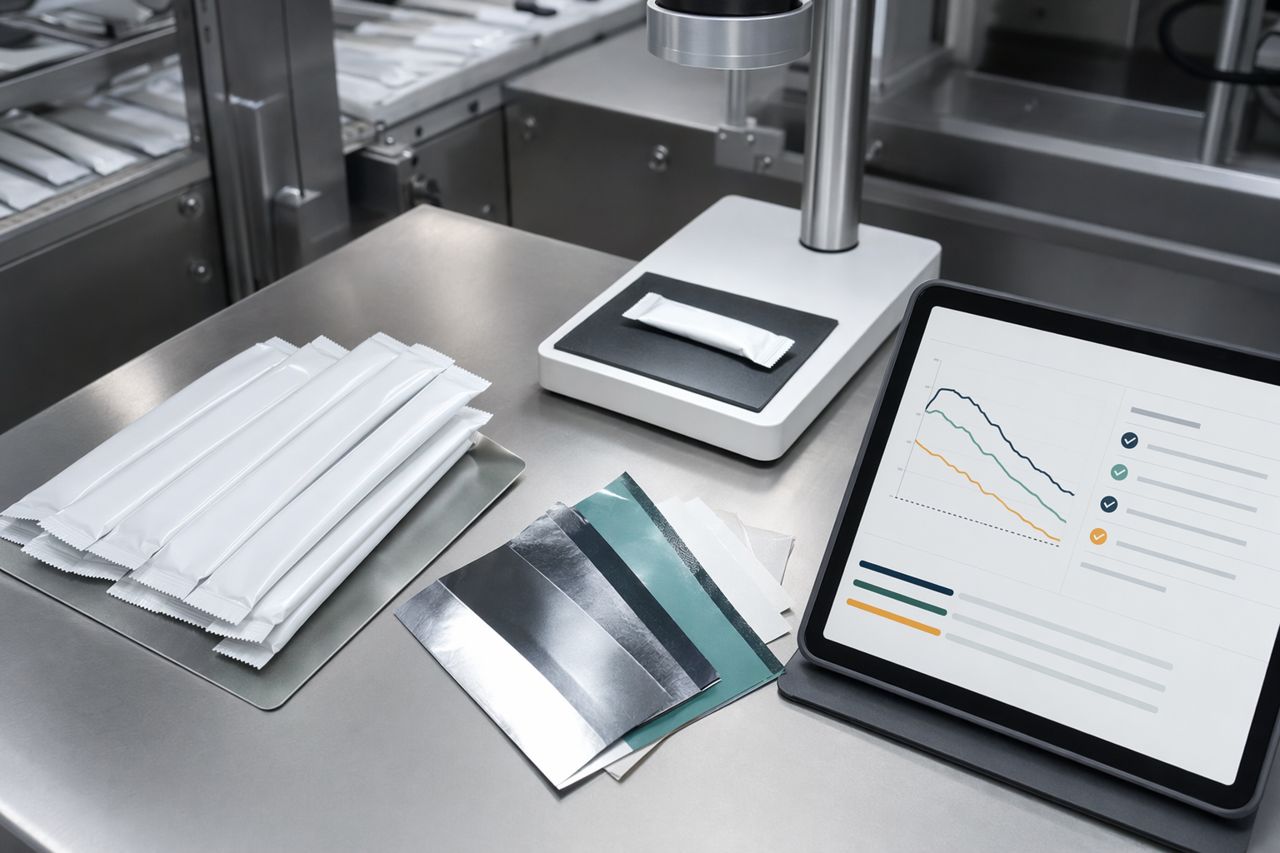
Packaging is part of the enzyme system. Stick-pack and sachet laminates should be selected for barrier performance, machinability, seal integrity, and product presentation.
Manufacturers should review:
- Film barrier requirements for the finished powder
- Seal temperature compatibility with the powder and line speed
- Risk of powder contamination in the seal area
- Pack stiffness and opening experience
- Secondary carton protection
- Storage and shipping conditions
A strong formulation can still fail commercially if the packaging does not protect it.
Documentation buyers should request
For B2B supplement manufacturing, ingredient documentation is as important as formulation performance. Before production, request a documentation pack aligned with your quality and regulatory workflow.
Typical documentation may include:
- Specification sheet
- Certificate of analysis
- Allergen statement
- GMO status statement, if required
- Country-of-origin information
- Ingredient composition or blend disclosure level appropriate to the project
- Food safety and quality certifications, where applicable
- Heavy metal and microbiological information
- Residual solvent or contaminant statements, where relevant
- Stability support or storage recommendations
Enzymeslink prepares enzyme supply discussions around the documentation your quality team needs to approve a commercial run.
Questions to ask before selecting a bulk enzyme supplier
When evaluating bulk digestive enzymes for supplement manufacturers, ask practical questions that connect formulation to production:
- Can the enzyme blend be customized for sachets or stick packs, not only capsules?
- What carrier options are available for powder flow and dispersion?
- How should the blend be handled during high-speed filling?
- Are flavor, acid, mineral, or fiber compatibility concerns expected?
- Can documentation be supplied early enough for internal approval?
- Is sourcing consistent across repeat production lots?
- Can the supplier support pilot-to-commercial scale-up discussions?
- Are packaging and storage recommendations available for sensitive powder formats?
The right supplier should help reduce formulation risk before procurement becomes urgent.
How Enzymeslink supports sachet and stick-pack projects
Enzymeslink works with supplement manufacturers developing digestive enzyme powders for single-serve formats. Our support is formulation-led and built for commercial execution.
We can help with:
- Custom digestive enzyme blend planning
- Enzyme spectrum selection for powder products
- Carrier and excipient compatibility discussions
- Powder format considerations for sachets and stick packs
- Documentation packages for quality review
- Sourcing consistency for repeat manufacturing
- Scale-up conversations with formulation, purchasing, and operations teams
We focus on practical B2B supply: the right enzyme blend, the right documentation, and the right production assumptions before the first commercial run.
Request a quote for a digestive enzyme powder project
If your team is developing a sachet or stick-pack digestive enzyme product, share your target format, ingredient list, packaging direction, and launch timeline.
Request a quote to start a formulation and supply conversation with Enzymeslink.