Moisture Control in Enzyme Supplement Packaging: Bottles, Blisters, Desiccants, and Line Practices
For dietary supplement manufacturers, moisture control is not a finishing detail. It is a core packaging design requirement for enzyme formulas.
Enzymes are functional proteins. They can be sensitive to water vapor, heat exposure, oxygen, and excipient interactions. A formula that looks stable in a bench sample can lose commercial robustness if the finished packaging system allows excess moisture ingress, traps humid headspace, or exposes capsules and tablets during filling.
This guide outlines practical packaging considerations for teams developing bulk digestive enzymes for supplement manufacturers, including bottle selection, blister formats, desiccant strategy, seal integrity, and line-level controls.
At Enzymeslink, we support formulation managers with enzyme blends designed for manufacturability: dosage-format compatibility, documentation alignment, sourcing consistency, and scale-up support without overstated consumer claims.
Why moisture control matters for enzyme supplements
Moisture affects enzyme products in several ways:
- Potency retention: Elevated moisture can accelerate loss of declared potency over shelf life.
- Physical integrity: Capsules may soften, become tacky, or show shell deformation. Tablets may pick up moisture, swell, chip, or change disintegration behavior.
- Blend flow: Hygroscopic excipients and fine enzyme powders can clump, bridge, or segregate under poor humidity control.
- Appearance: Speckling, caking, discoloration, and capsule haze can create avoidable quality concerns.
- Packaging performance: A weak bottle, closure, liner, or blister structure can undermine an otherwise sound formulation.
For commercial production, the question is not simply whether the enzyme blend is stable. The better question is whether the formula, dosage form, packaging, and filling environment work together as a controlled system.
Start with the enzyme blend and dosage format
Moisture-control decisions should begin before packaging procurement. Review the full formula architecture:
- Enzyme types and blend complexity
- Carrier system and powder morphology
- Capsule, tablet, stick pack, or sachet format
- Mineral salts, acids, botanicals, probiotics, fibers, or other moisture-active components
- Target shelf life and distribution geography
- Expected warehouse and retail conditions
- Bottle count, fill volume, and headspace
A multi-enzyme digestive formula may have different moisture exposure risk than a simple single-enzyme capsule. A capsule with hygroscopic excipients may need more packaging protection than the enzyme blend alone would suggest.
Key formulation questions
Before locking the packaging brief, ask:
- Does the finished blend flow consistently after short-term humidity exposure?
- Does the capsule or tablet remain visually acceptable under packaging stress?
- Does the formula contain ingredients that release or attract moisture?
- Is the product likely to ship through hot or humid regions?
- Will the contract manufacturer fill in a humidity-controlled room?
- Will the brand require a long shelf-life claim or a shorter commercial dating period?
These answers shape the packaging system more reliably than generic packaging preferences.
Bottles: practical, scalable, and widely accepted
Bottles remain the most common format for enzyme supplement capsules and tablets because they are scalable, familiar to consumers, and compatible with high-speed lines.
Bottle material considerations
Common bottle options include:
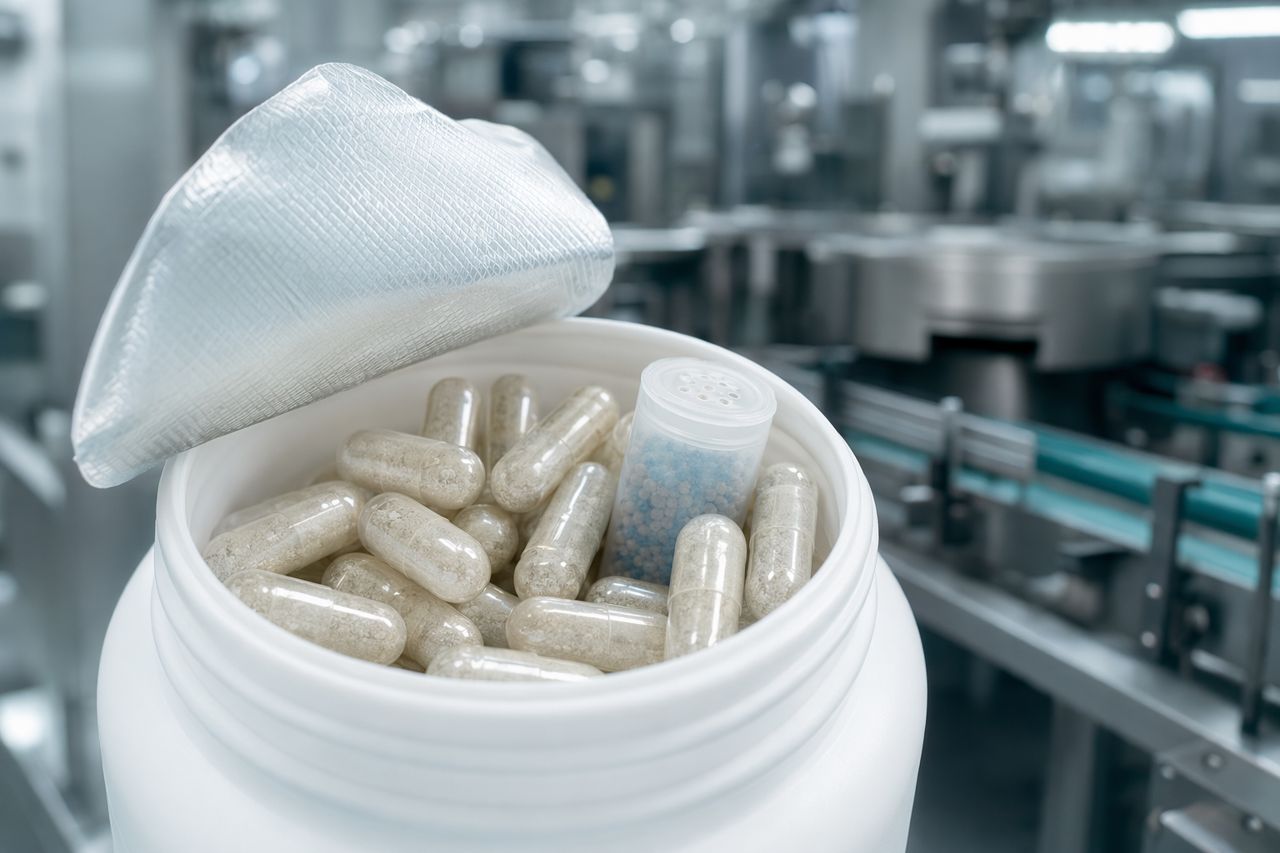
- HDPE: Widely used, durable, opaque, and suitable for many supplement formats. Often paired with desiccants and induction seals.
- PET: Clear appearance is useful for some brands but may require careful light and moisture evaluation.
- Glass: Premium appearance and low vapor transmission, but heavier, breakable, and less line-flexible.
For enzyme supplements, the bottle should be selected based on barrier performance, fill-count geometry, closure compatibility, and distribution realities, not only visual preference.
Closure and liner details matter
A good bottle can underperform if the closure system is weak. Review:
- Cap fit and torque control
- Induction seal compatibility
- Liner material and compression behavior
- Tamper-evident requirements
- Reseal performance after consumer opening
- Thread finish consistency
Induction sealing is often valuable because it helps protect the unopened product from moisture ingress and provides tamper evidence. However, it does not solve all post-opening moisture exposure. For multi-count bottles, the desiccant strategy and consumer-use period still matter.
Headspace and fill count
Large headspace can increase the moisture burden inside the package. A 30-count bottle and a 180-count bottle may require different evaluations even if the formula is identical.
Consider:
- Bottle size relative to fill volume
- Number and size of desiccants
- Capsule shell moisture level before filling
- Time between filling, sealing, and final packing
- Expected open-and-close frequency during consumer use
For enzyme supplements, packaging trials should evaluate the actual finished product in the intended bottle size, not only the raw blend.
Blisters: strong unit-dose protection when designed correctly
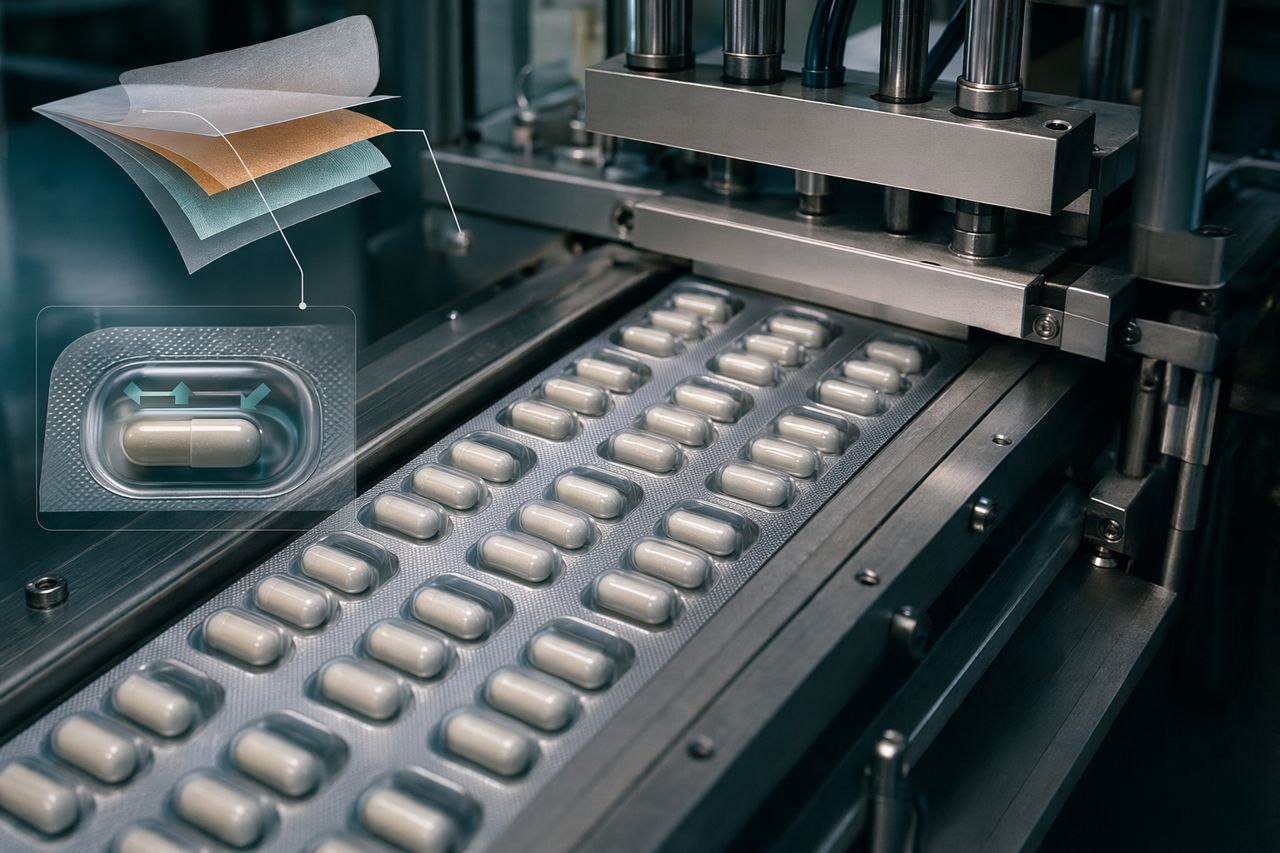
Blister packaging can offer meaningful advantages for enzyme products, especially where unit-dose protection, portability, or premium presentation is required.
Benefits of blister formats
Blisters can help reduce repeated exposure because each capsule or tablet remains sealed until use. This can be useful for formulas with higher moisture sensitivity or for markets with humid conditions.
Potential advantages include:
- Unit-dose moisture protection
- Reduced consumer handling exposure
- Strong tamper evidence
- Controlled presentation for clinical or practitioner channels
- Easier sample and travel formats
Blister structure selection
Not all blisters provide the same barrier. Packaging teams should compare forming films and lidding foils based on the finished product risk profile.
Common considerations include:
- Cold-form foil versus thermoform structures
- Cavity size and product fit
- Seal integrity across the web
- Pinholes, channel leaks, and handling damage
- Carton protection during transport
- Compatibility with capsule shell and tablet surface
Blisters can be more expensive and may require longer packaging lead times than bottles, but for certain enzyme formulas, the unit-dose barrier may justify the added complexity.
Desiccants: choose by moisture load, not habit
Desiccants are often included in enzyme supplement bottles, but the selection should be deliberate.
Common desiccant formats
- Canisters: Rigid, clean handling, common in automated insertion systems.
- Sachets: Flexible and available in many sizes, but require line compatibility and consumer-safety review.
- Integrated closures: Useful for some formats, especially where loose desiccants are undesirable.
Common desiccant materials
- Silica gel: Broadly used and effective for many supplement applications.
- Molecular sieve: Stronger moisture adsorption in low-humidity environments, but should be evaluated for formula compatibility.
- Clay: Cost-effective for certain use cases, though performance depends on the application.
Desiccant sizing considerations
Desiccant choice depends on:
- Bottle material and wall thickness
- Closure and liner performance
- Fill count and headspace
- Initial moisture level of capsules, tablets, and excipients
- Expected shelf life
- Climate zones and shipping lanes
- Consumer-use pattern after opening
Over-specifying a desiccant can add cost and may create unintended product interactions. Under-specifying it can compromise shelf-life confidence. The right approach is packaging-specific evaluation with the final formula and final components.
Line practices: the packaging room is part of the formula
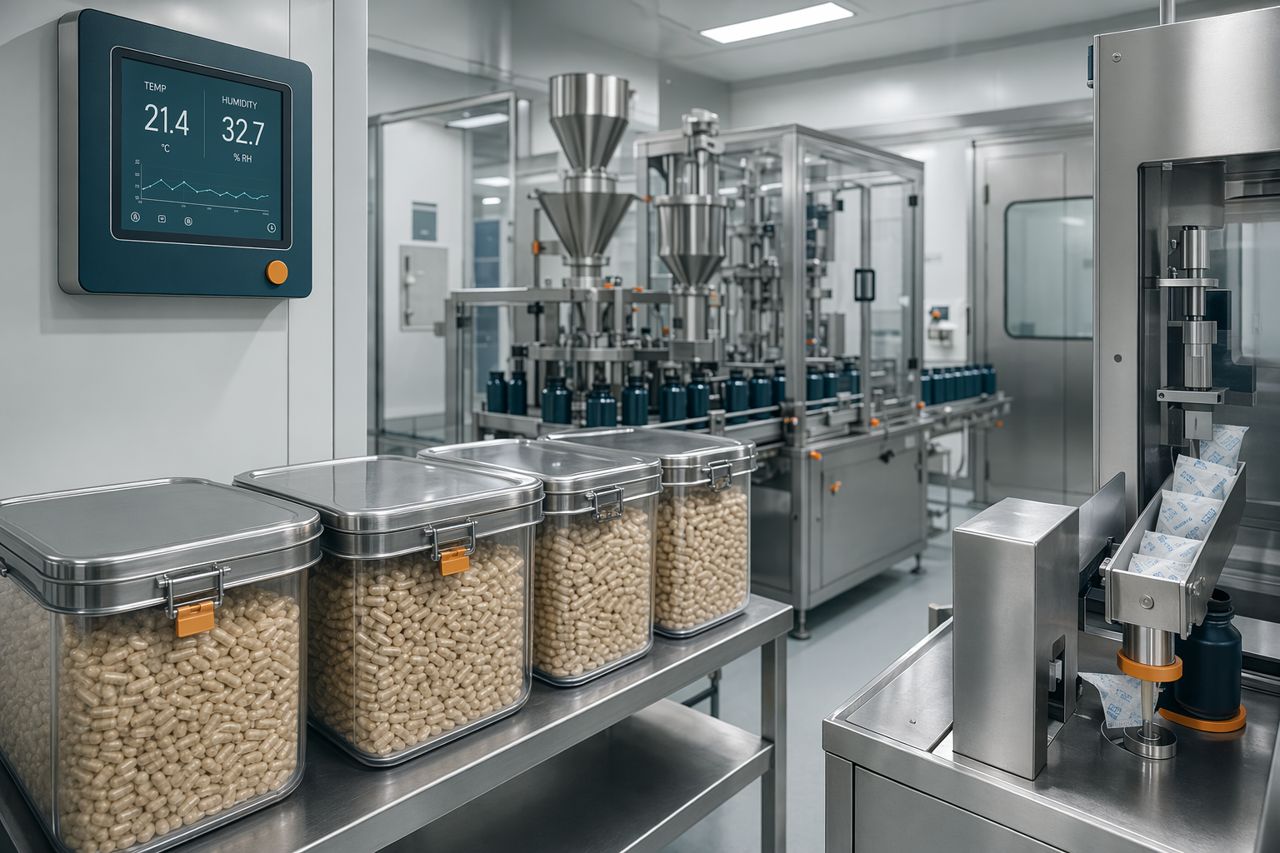
Moisture control does not start at the bottle. It starts when bulk blend, capsules, or tablets are exposed to the production environment.
High-risk production moments
Key exposure points include:
- Blend staging before encapsulation or tableting
- Hopper dwell time
- Capsule or tablet bulk storage before packaging
- Open bottle accumulation before filling
- Desiccant insertion delays
- Time between filling and induction sealing
- Rework or line stoppages
Even a well-specified bottle can underperform if the product sits exposed in a humid room before closure.
Practical line controls
Manufacturers should document and control:
- Packaging room temperature and humidity targets
- Maximum open-exposure time
- Closed-bin or lined-container staging
- In-process checks for fill, cap, seal, and desiccant presence
- Line clearance to avoid desiccant or component mix-ups
- Hold-time limits for unfinished goods
- Post-seal inspection frequency
These controls should be realistic for the actual facility. A packaging plan that depends on perfect handling may not survive scale-up.
Compatibility with capsules, tablets, and powders
Different dosage formats create different moisture-control requirements.
Capsules
Capsules can exchange moisture with the environment. Low moisture may make shells brittle; high moisture may make them soft or tacky. Enzyme capsule formulas should be reviewed for:
- Capsule shell type
- Powder fill moisture behavior
- Electrostatic handling
- Capsule lock integrity
- Visual appearance after packaging stress
- Bottle or blister fit
Tablets
Tablets may allow more formulation flexibility but require attention to excipient selection and compression behavior. For enzyme tablets, evaluate:
- Hardness and friability after storage
- Disintegration behavior
- Coating compatibility if used
- Moisture-active excipients
- Tablet dust generation during filling
Powders, sachets, and stick packs
Powder formats can be more exposed to humidity during filling and consumer use. Consider:
- Film barrier selection
- Seal quality
- Powder flow under humidity stress
- Clumping and dose uniformity
- Flavor system compatibility
- Consumer handling after opening
For all formats, packaging should be matched to the formula instead of forcing the formula into a preselected pack.
Documentation buyers should request
A strong enzyme ingredient and blend partner should support packaging decisions with practical documentation. For B2B buyers, useful documentation may include:
- Ingredient specification sheet
- Allergen and dietary-position documentation where applicable
- Country-of-origin and supply-chain statements
- Stability-support data or packaging-study summaries when available
- Formula compatibility notes
- Recommended storage and handling guidance
- Manufacturing and quality documentation required for supplier qualification
For custom enzyme blends, request documentation early. Packaging, claims review, purchasing, quality, and contract manufacturing teams all need aligned information before launch.
Packaging trial design: what to evaluate before scale-up
A packaging trial does not need to be overly complex, but it should be relevant to commercial conditions.
Recommended trial variables
Evaluate the finished dosage form in:
- Intended bottle resin and size
- Intended closure and liner
- Selected desiccant type and quantity
- Alternate desiccant option if risk is high
- Blister structure if under consideration
- Representative shipping and warehouse conditions
- Final label and carton configuration if heat or light exposure is relevant
Recommended observations
Track:
- Appearance changes
- Odor changes
- Capsule or tablet handling behavior
- Clumping, dusting, or breakage
- Seal performance
- Desiccant presence and placement
- Potency retention against the product specification
The objective is to confirm that the commercial packaging system supports the declared product profile through the intended dating period.
Common packaging mistakes in enzyme supplement launches
Avoid these preventable issues:
- Selecting bottle style before evaluating formula moisture risk.
- Assuming a desiccant can compensate for weak line controls.
- Using a clear bottle for visual appeal without barrier and light review.
- Running packaging trials in a different bottle size than launch size.
- Ignoring cap liner and induction-seal compatibility.
- Leaving filled bottles unsealed during line interruptions.
- Treating capsule shell behavior as separate from enzyme stability.
- Changing excipients late without revisiting packaging risk.
- Failing to document humidity exposure limits for the co-manufacturer.
- Launching into humid markets without packaging-system confirmation.
How Enzymeslink supports moisture-conscious enzyme formulation
Enzymeslink works with dietary supplement manufacturers developing enzyme-based products for capsules, tablets, powders, and custom blends. Our role is to help your team connect formula design with manufacturing reality.
We can support:
- Custom digestive enzyme blend development
- Excipient and carrier compatibility review
- Dosage-format planning for capsules, tablets, and powders
- Supplier documentation for qualification workflows
- Batch-to-batch sourcing consistency
- Scale-up discussions with your contract manufacturer
- Packaging-risk conversations before launch decisions are fixed
We do not position packaging as an afterthought. For enzyme products, packaging is part of the finished specification.
Buyer checklist for moisture-control planning
Use this checklist before approving production packaging:
- Has the finished formula been reviewed for moisture sensitivity?
- Is the dosage format compatible with the chosen packaging system?
- Has the bottle or blister structure been evaluated using the launch formula?
- Is the desiccant type and size justified by product risk?
- Are closure, liner, and induction seal components confirmed?
- Are humidity and exposure limits documented for the packaging line?
- Are hold times defined for bulk product and filled-but-unsealed containers?
- Does the contract manufacturer have practical controls for desiccant insertion?
- Is packaging documentation aligned with quality and regulatory expectations?
- Is there a plan to review performance after first commercial production?
Build the enzyme formula and package as one system
Moisture control is a cross-functional decision. Formulation, procurement, quality, packaging engineering, and manufacturing all influence the outcome.
For enzyme supplement brands, the best results come from designing the blend, dosage format, and packaging system together. That approach reduces launch risk, improves documentation readiness, and gives buyers a clearer path from pilot batch to commercial production.
If your team is developing a digestive enzyme supplement and needs bulk enzyme blend support, Enzymeslink can help align the formula with packaging and scale-up requirements.
Request a quote through our on-site form to discuss your enzyme blend, dosage format, packaging direction, and production timeline.